
The first step in the evolution of your new client process is to document each of the contact points that currently exist when you bring new people into your business. You will then compile, into one location, all of the material, notes and media that you use as part of your client touch points and communication such as emails, scripts, letters of engagement etc.
For ease of use and consistency we are going to use a spreadsheet in combination with a cloud-based document solution (Google Docs or Microsoft OneDrive) to bring this together … but more about that later!
You will find that as you progress you will recognise that things may not be entirely consistent or documented or will vary between the client professionals within your business. This is normal and we ask that you do your best not to shift into ‘fixing mode’ yet or into over-thinking what should go where. After all, our intent is to iterate and evolve what you have, to fix the gaps and improve the experience (but not yet). First you need to work out where you are already at and what you have available to work with.
As the foundation of your progress, you need a ‘best guess’ snapshot as to what takes place (or should take place) across the majority of your new client engagements. If there are slightly different steps for different situations, teams or professionals, then include each of the variants with notes (or create another spreadsheet/s to reflect more significant differences).
We are going to use a fairly basic spreadsheet template as the framework for this exercise. This spreadsheet is designed to be a guide template rather than an exhaustive list of options or a complete framework. We suggest that you stick to the columns we have created, however, you should feel free to create your own naming conventions for the touch-points / steps and the stages within which they fall.
The style of services you provide and the culture and history of your business will shape the exact nature of the process you go through and the material you use in your new client engagement system. Simply put, use the framework (headings and columns) but adjust the content, as what we have provided is intended as a sample only. You could use the example provided ONLY if matches your language and “culture”.
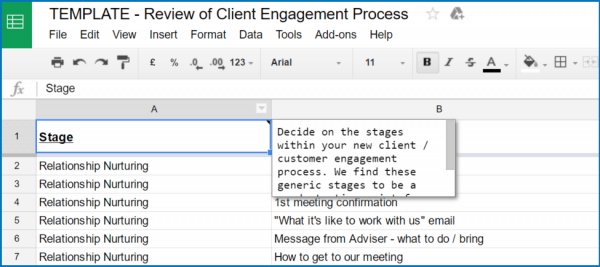
As demonstrated in the image, if you hover your mouse in each column’s heading cell, you will see that there are additional notes to assist your journey.

Some other columns you may wish to add as you progress through this process:
Once you have identified each of the steps in your existing ‘new client’ engagement experience, bring together all of the material that you have that makes up a part of this process.
You should consider but not limit yourself to:
It is important that every one of these items can be stored online with a link that can be directly copied into your client experience spreadsheet. It is not enough that you know they exist or that they exist in a form that you cannot create a link to (a CRM etc). It is critical that you start your project free of obstacles and the right foundation and that means being able to link directly to your collateral within this spreadsheet time and time again.
This means that you may need to:
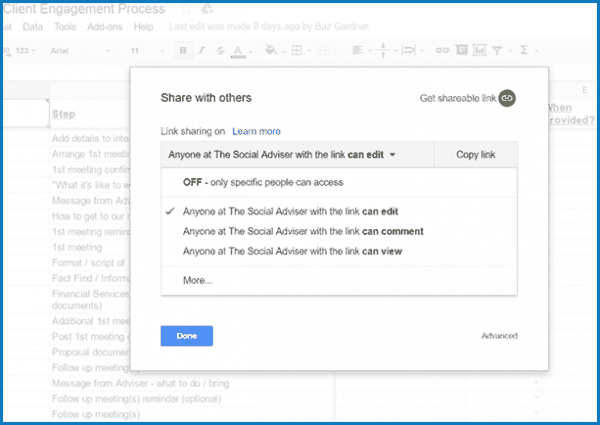
Once you have completed this process paste all of the relevant links to your collateral into your spreadsheet so that you can see what material is available at each touch point for new clients.
You should also ensure that you have selected the relevant privacy / share status for each of these items as fits your needs.
<<< This image shows some of the sharing options available for Google Sheets.
If there any any proprietary documents that you do not wish to share outside of your own team you can simply set these to reflect this. However we encourage you to set as much of the content as possible to ‘anyone with the link can view’ so that you can seek feedback from our team and your peers throughout the iteration process.
We find this philosophy will create results far in excess of any perceived risk you may hold for sharing your systems within what is a limited forum. However there are also cases where you are restricted from sharing items and we trust that you will know when they are and set your sharing status accordingly.
By going through this process now it will make it far easier later for you to edit, maintain version control of edits (one version which is tracked online), share your spreadsheet with us and your peers for input (but still retain confidentiality where required) and most importantly find, prioritize and iterate quickly in the later stages of this project.
Ok, time to get to work!

As you have been completing the gathering process outlined in step 1.1, you will likely have also been coming up with ideas for additional steps or refinements to your existing engagement protocols.
Now is the time to compile your notes / thinking and to insert any steps you are considering adding into the spreadsheet. If you have ideas on how to improve your existing material then make sure to add the notes into the spreadsheet. If you require more detailed notes or are working on new variants that are not yet ready to replace the existing ones, then simply create a Google Doc for example and provide the shareable link within your spreadsheet.
For any new steps you are considering adding to your process, create a new line and add your notes and links to any working material. As this is not yet a step that exists, we suggest that you fill the line in your sheet as a different colour to denote that it is a planned rather than existing step.
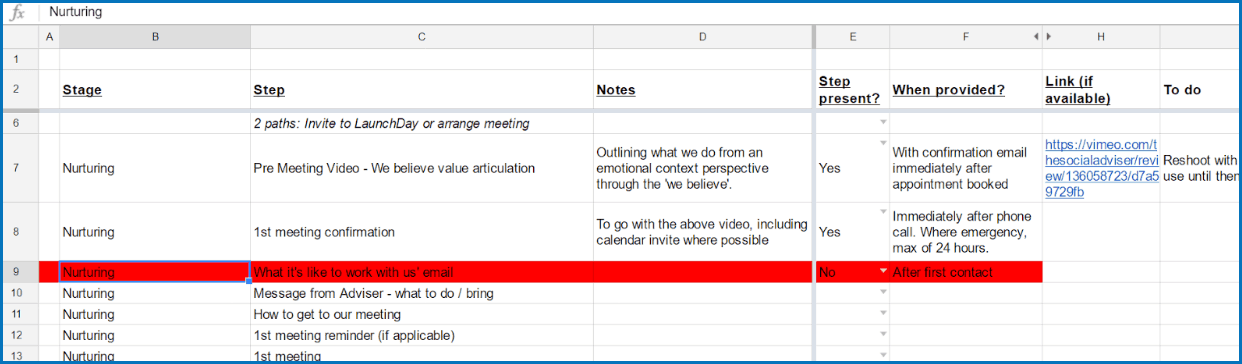
You can see in the example above we have added a potential step to our process; an email we have titled ‘What it’s like to work with us’.
It’s exciting to see the many ways that you can now be improving your existing ‘new client’ experience, however, we would encourage you not to spend too much time just yet on building your new process. To create the best iteration in the shortest amount of time requires a methodical process; rather than rushing at things piecemeal we are going to work through a few more steps before we start moving into the creation stages.